Ask the Artist: Jon-Paul Wheatley
Meet the man behind Jon-Paul's Balls — the wildly creative maker whose hand-stitched footballs have captivated millions online and now call our stateside Hox Galleries home.
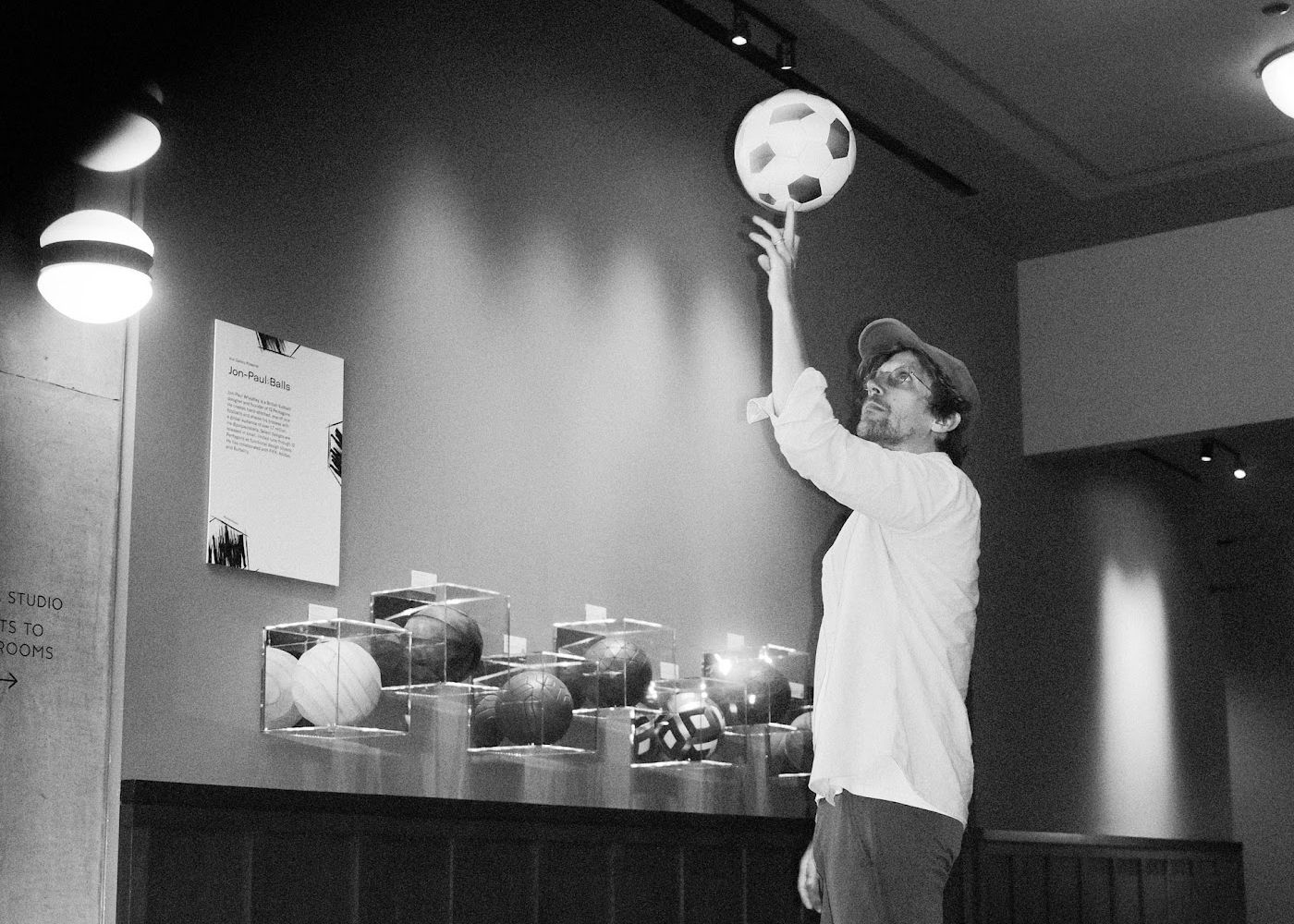
Jon-Paul Wheatley has been making things for as long as he can remember. Fueled by equal parts curiosity and creativity, he’s built a habit of taking ideas a little too far — starting in the realm of UX design and apps, eventually evolving to the one-of-one footballs that now spill out of his studio.
Like many during the pandemic, that curious spirit sparked a few new hobbies. Who knew some unexpected free time and a set of leather-working tools would lead him down a path of meticulous football design — and the wildly satisfying videos documenting each creation along the way?
Lucky for us, Jon-Paul has scattered his one-of-one footballs across our US Hoxtons — Williamsburg, Chicago, Portland, and Downtown LA — where they’ll live in our Hox Galleries through July 20, 2026.
While these works of art aren’t for sale, you can take a stab at designing your own through The Badly Drawn Ball. Sketch a football, add it to the growing gallery of submissions, and explore balls inspired by the collective creativity of the community through his brand, 12 Pentagons.
We sat down with Jon-Paul to dive a little deeper into his creative practice, what fuels his work, and his partnership with The Hox.
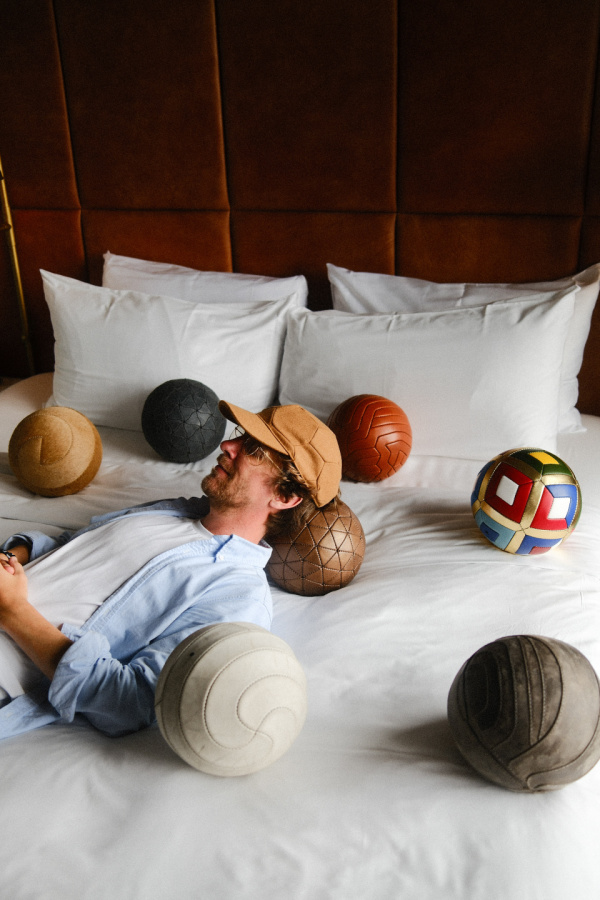
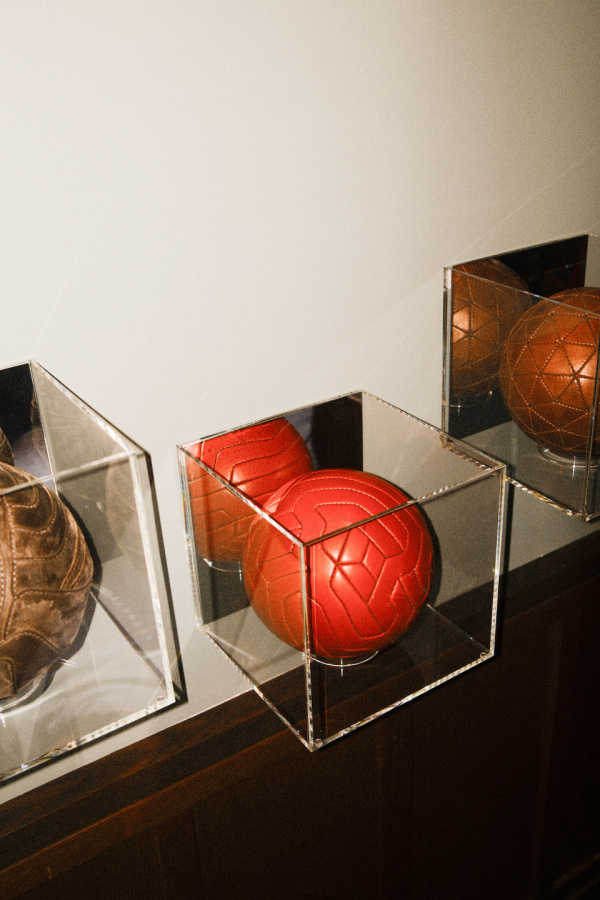
The Hoxton is fortunate enough to have a curation of your one-of-one, hand-stitched footballs on display across our stateside hotels throughout the big tournament. Of the balls on display, which one has the best story behind it?
The best story, I think, is probably the combined first World Cup ball. In the first World Cup (in 1930), the 2 teams playing in the final could not agree on which ball to use. Argentina wanted to play with their own ball (The Tiento), while Uruguay wanted to use the T-Model.
The compromise was to play with 1 ball in the first half and 1 ball in the second half. A reasonable compromise, perhaps.
This ball represents an alternate solution. I combined both balls into 1.
How did you even start designing footballs, and if 10-year-old Jon-Paul were to see you now, what do you think he’d think of how you’ve managed to carve out a creative path like this?
He’d probably laugh, and not believe it. I had dreams of becoming a professional footballer when I was a kid. The only issue was: I was rubbish and never had a chance. My mum was nice enough to let me delude myself into thinking this was a viable path for a few years, then I slowly grew out of it.
So no, 10-year-old me wouldn’t have predicted this. But I don’t think he’d be disappointed either. The football obsession never went anywhere, it just found a different outlet.
In a world of instant gratification, what draws you to a design practice built on patience and delayed gratification? And how has that shaped the way you document the football-making process?
It does take a while to make each ball. I think that’s kind of funny, honestly. I like doing things and working on projects that would be considered not commercially viable by most other brands. We spent years, for example, trying to make the Badly Drawn Ball worse. It’s a lot more work to make a ball that way, and the result is worse. I think that’s funny.
But there’s a good carrot at the end of every project, which is the moment I inflate the ball for the first time and see it come to life. Then I get to play with it. That moment makes all the slow bits worth it.
As for documenting, the process is where everything interesting happens. The finished ball is just the last frame. All the dead ends and the bits that went wrong are usually more fun than the thing that worked, so those are what I try to capture.
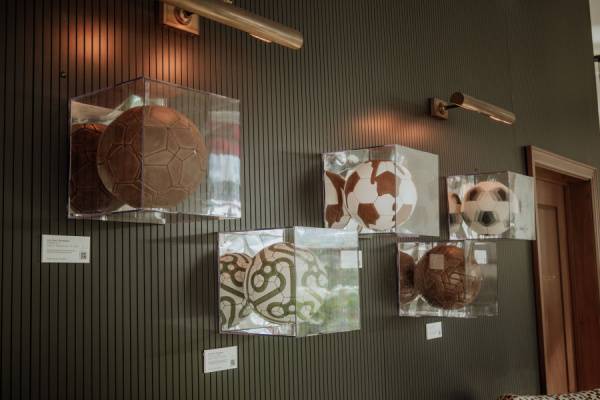
Your work is incredibly playful and often pushes the boundaries of what a football can be. What sparks that sky’s-the-limit approach to design?
It’s something to do, isn’t it!
The big brands play a different game. They buy the rights. That makes the balls iconic by default. If a ball gets used in the Prem, or the World Cup, it’s iconic. The game gives it the story.
Other brands fall into the trap of trying to mimic the styles of those balls, and I think they always fall short. They feel like cheaper knockoffs of “the” ball that was used in “the” game.
We play in a totally different area. We explore the ball from first principles. It can’t borrow its story from a famous match, so it has to stand on its own and earn it. That’s where the freedom comes from. When nothing’s riding on a tournament result, you can take the ball anywhere you want.
Hotels aren’t the most traditional setting for showcasing art. What excites you most about bringing your work into a space where people might stumble upon it unexpectedly in our Hox Galleries?
[My wife] Allison and I are big fans of The Hoxton. The brand, the design, the whole experience of staying in one. It’s the kind of thing we aspire to build with 12 Pentagons, so it’s an honour to be included and to collaborate with a brand we’re actually fans of.
As for the unexpected setting, I think that suits the work. A gallery tells you in advance that you’re meant to take something seriously. A ball you come across in a hotel doesn’t announce itself. You stumble on it, and you get to decide for yourself what it is. That’s a better way to meet a football, I think.
You’ve asked the internet to draw you a ball, and thousands of people answered the call. The Badly Drawn Ball lives on, and now we’ve invited our Hox community to join in. What is it about the idea of a “badly drawn ball” that gives people permission to be creative?
People are creative! The “badly drawn” part just takes the pressure off. The moment you call it badly drawn, there’s no bar to clear. You can’t get it wrong. Nobody’s grading it.
Your work sits somewhere between sport, art and design. Where do you think it belongs – or is that the wrong question? And, as everyone always asks… can you actually play with them?!
We aspire to make things people consider art, but my background is in product design, and that’s always been how I think about them. A ball has a job to do. It has constraints, a function, it has to actually work. I’m not starting from “what does this mean,” I’m starting from “how is this made and what is it for.”
So I don’t lose much sleep over where it belongs. The category is everyone else’s problem, not mine. I’d rather make the thing and let people argue about which shelf it goes on. If it ends up in a gallery, great. If someone kicks it around a five-a-side pitch, also great.
And yes, please play with them! That’s important to me. A ball you can’t play with is just a sculpture of a ball, and I’m not interested in making those.
When you travel, what’s the #1 thing you do in any city to find inspiration?
A pub.
Related Stories

Your Ultimate Gift Guide With
The Go-To
We sat down with Victoire Tardy -Joubert, The Go-To founder and gifting expert to give us a masterclass on the best gifts this season, how to find hidden giftable gems while tra...

Meet The Locals:
Edinburgh Craft And Design Hub Bard
Hugo Macdonald and James Stevens, co-founders of Edinburgh-based shop and gallery Bard, believe that craft and design can elevate our daily experience, both at home and in the w...

DJ Pinky Perzelle Explores
The Best Vinyl Shops In Soho
There probably aren’t many more suited to giving an insight into the musical bones of Soho, London, than our pal Sonny Rooney. A Londoner born and bred, Sonny Rooney, aka Pinky ...